A quarter of a century of polar mesospheric summer echo observations over Andøya: climatology and trends
Leibniz Institute of Atmospheric Physics at the Rostock University, Schloss-Str. 6, 18225 Kühlungsborn, Germany
Franz-Josef Lübken
Leibniz Institute of Atmospheric Physics at the Rostock University, Schloss-Str. 6, 18225 Kühlungsborn, Germany
Related authors
Alex Timothy Chartier, Ryan Poffenbarger, Rafael Mesquita, Diego Janches, Jorge Chau, Toralf Renkwitz, Ralph Latteck, and William Bristow
EGUsphere, https://doi.org/10.5194/egusphere-2026-1634, https://doi.org/10.5194/egusphere-2026-1634, 2026
Short summary
Short summary
We created a new long-term record of upper atmosphere winds using data from a global network of radars spanning more than 30 years. Because these measurements do not directly show altitude, we developed a method to estimate where the signals come from and tested it against other observations and models. The results show good agreement, meaning these data can now be used with greater confidence to study atmospheric motion and its effects on communication and space systems.
Toralf Renkwitz, Matthias Clahsen, and Ralph Latteck
Atmos. Meas. Tech., 19, 1825–1835, https://doi.org/10.5194/amt-19-1825-2026, https://doi.org/10.5194/amt-19-1825-2026, 2026
Short summary
Short summary
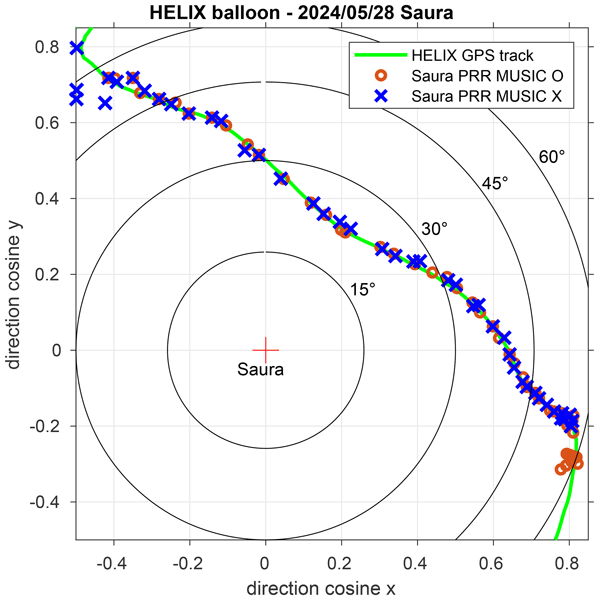
We describe the use of a nearby drifting stratospheric balloon to calibrate three different radar systems. While for radars in the VHF range different calibration options exist, it is much more complicate to do this in the lower HF range. The main complication is the required distance and size of the target, which is especially challenging for vertical pointing radars. We also present the validation of proper phase calibration and the general radiation pattern.
J. Federico Conte, Jorge L. Chau, Toralf Renkwitz, Ralph Latteck, Masaki Tsutsumi, Christoph Jacobi, Njål Gulbrandsen, and Satonori Nozawa
Ann. Geophys., 43, 603–619, https://doi.org/10.5194/angeo-43-603-2025, https://doi.org/10.5194/angeo-43-603-2025, 2025
Short summary
Short summary
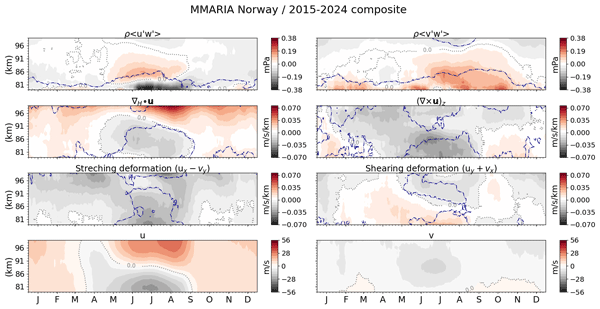
Analysis of 10 years of continuous measurements provided MMARIA/SIMONe Norway and MMARIA/SIMONe Germany reveals that the divergent and vortical motions in the mesosphere and lower thermosphere exchange the dominant role depending on the height and the time of the year. At summer mesopause altitudes over middle latitudes, the horizontal divergence and the relative vorticity contribute approximately the same, indicating an energetic balance between mesoscale divergent and vortical motions.
Devin Huyghebaert, Juha Vierinen, Björn Gustavsson, Ralph Latteck, Toralf Renkwitz, Marius Zecha, Claudia C. Stephan, J. Federico Conte, Daniel Kastinen, Johan Kero, and Jorge L. Chau
EGUsphere, https://doi.org/10.5194/egusphere-2025-2323, https://doi.org/10.5194/egusphere-2025-2323, 2025
Short summary
Short summary
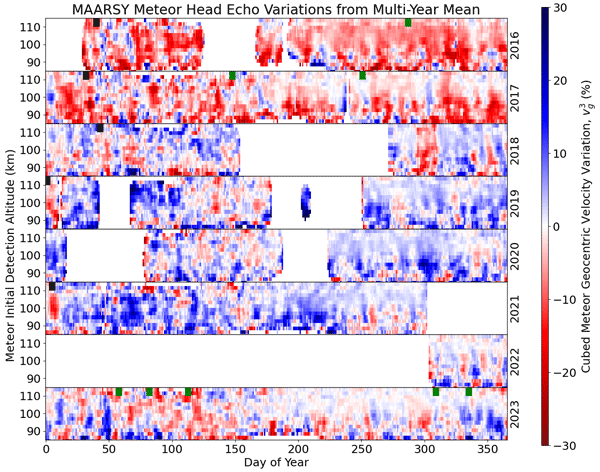
The phenomena of meteors occurs at altitudes of 60–120 km and can be used to measure the neutral atmosphere. We use a large high power radar system in Norway (MAARSY) to determine changes to the atmospheric density between the years of 2016–2023 at altitudes of 85–115 km. The same day-of-year is compared, minimizing changes to the measurements due to factors other than the atmosphere. This presents a novel method by which to obtain atmospheric neutral density variations.
Christoph Jacobi, Khalil Karami, Ales Kuchar, Manfred Ern, Toralf Renkwitz, Ralph Latteck, and Jorge L. Chau
Adv. Radio Sci., 23, 21–31, https://doi.org/10.5194/ars-23-21-2025, https://doi.org/10.5194/ars-23-21-2025, 2025
Short summary
Short summary
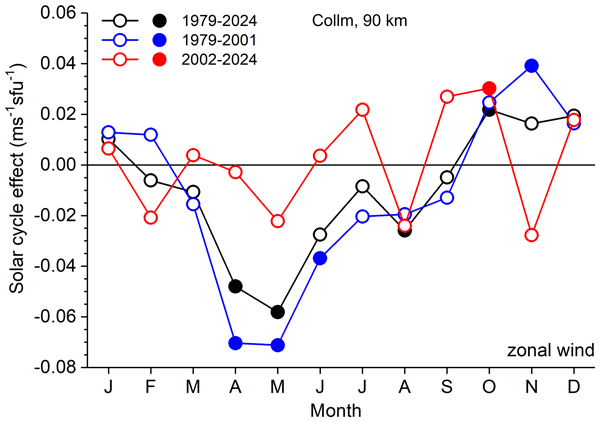
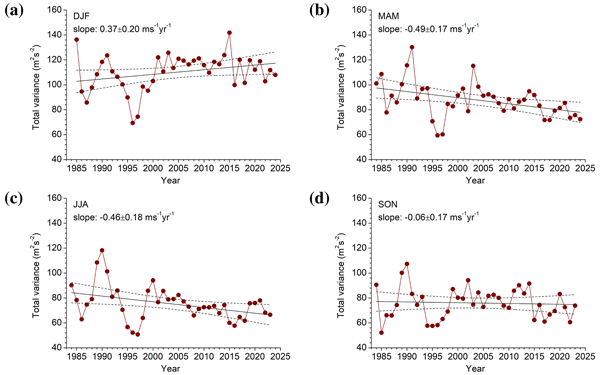
Half-hourly mean winds have been obtained using ground-based low-frequency and very high frequency radio observations of the mesopause region at Collm, Germany, since 1984. Long-term changes of wind variances, which are proxies for short-period atmospheric gravity waves, have been analysed. Gravity wave amplitudes increase with time in winter, but mainly decrease in summer. The trends are consistent with mean wind changes according to wave theory.
Ralph Latteck and Damian J. Murphy
Ann. Geophys., 42, 55–68, https://doi.org/10.5194/angeo-42-55-2024, https://doi.org/10.5194/angeo-42-55-2024, 2024
Short summary
Short summary
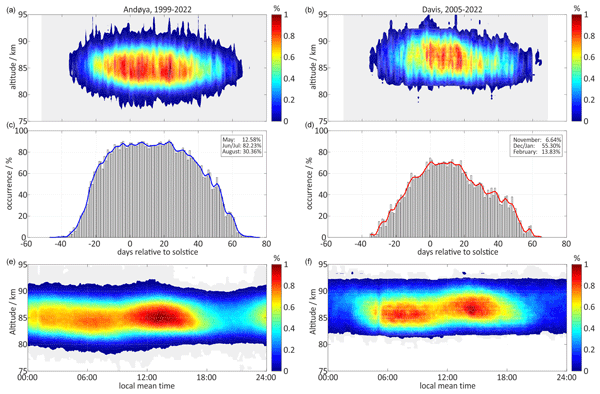
This paper gives an overview of continuous measurements of polar mesophere summer echoes (PMSE) by VHF radars at Andøya (69° N) and Davis (69° S). PMSE signal strengths are of the same order of magnitude; significantly fewer PMSE were observed in the Southern than the Northern Hemisphere. Compared to Andøya, the PMSE season over Davis starts ~7 d later and ends 9 d earlier; PMSE occur less frequently but with greater seasonal/diurnal occurrence variability, reaching higher peak altitudes.
Jennifer Hartisch, Jorge L. Chau, Ralph Latteck, Toralf Renkwitz, and Marius Zecha
Ann. Geophys., 42, 29–43, https://doi.org/10.5194/angeo-42-29-2024, https://doi.org/10.5194/angeo-42-29-2024, 2024
Short summary
Short summary
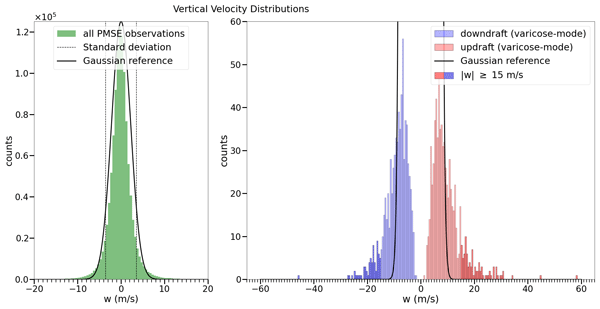
Scientists are studying the mesosphere and lower thermosphere using radar in northern Norway. They found peculiar events with strong upward and downward air movements, happening frequently (up to 2.5 % per month) from 2015 to 2021. Over 700 such events were noted, lasting around 20 min and expanding the studied layer. A total of 17 % of these events had extreme vertical speeds, showing their unique nature.
Alex Timothy Chartier, Ryan Poffenbarger, Rafael Mesquita, Diego Janches, Jorge Chau, Toralf Renkwitz, Ralph Latteck, and William Bristow
EGUsphere, https://doi.org/10.5194/egusphere-2026-1634, https://doi.org/10.5194/egusphere-2026-1634, 2026
Short summary
Short summary
We created a new long-term record of upper atmosphere winds using data from a global network of radars spanning more than 30 years. Because these measurements do not directly show altitude, we developed a method to estimate where the signals come from and tested it against other observations and models. The results show good agreement, meaning these data can now be used with greater confidence to study atmospheric motion and its effects on communication and space systems.
Toralf Renkwitz, Matthias Clahsen, and Ralph Latteck
Atmos. Meas. Tech., 19, 1825–1835, https://doi.org/10.5194/amt-19-1825-2026, https://doi.org/10.5194/amt-19-1825-2026, 2026
Short summary
Short summary
We describe the use of a nearby drifting stratospheric balloon to calibrate three different radar systems. While for radars in the VHF range different calibration options exist, it is much more complicate to do this in the lower HF range. The main complication is the required distance and size of the target, which is especially challenging for vertical pointing radars. We also present the validation of proper phase calibration and the general radiation pattern.
J. Federico Conte, Jorge L. Chau, Toralf Renkwitz, Ralph Latteck, Masaki Tsutsumi, Christoph Jacobi, Njål Gulbrandsen, and Satonori Nozawa
Ann. Geophys., 43, 603–619, https://doi.org/10.5194/angeo-43-603-2025, https://doi.org/10.5194/angeo-43-603-2025, 2025
Short summary
Short summary
Analysis of 10 years of continuous measurements provided MMARIA/SIMONe Norway and MMARIA/SIMONe Germany reveals that the divergent and vortical motions in the mesosphere and lower thermosphere exchange the dominant role depending on the height and the time of the year. At summer mesopause altitudes over middle latitudes, the horizontal divergence and the relative vorticity contribute approximately the same, indicating an energetic balance between mesoscale divergent and vortical motions.
Devin Huyghebaert, Juha Vierinen, Björn Gustavsson, Ralph Latteck, Toralf Renkwitz, Marius Zecha, Claudia C. Stephan, J. Federico Conte, Daniel Kastinen, Johan Kero, and Jorge L. Chau
EGUsphere, https://doi.org/10.5194/egusphere-2025-2323, https://doi.org/10.5194/egusphere-2025-2323, 2025
Short summary
Short summary
The phenomena of meteors occurs at altitudes of 60–120 km and can be used to measure the neutral atmosphere. We use a large high power radar system in Norway (MAARSY) to determine changes to the atmospheric density between the years of 2016–2023 at altitudes of 85–115 km. The same day-of-year is compared, minimizing changes to the measurements due to factors other than the atmosphere. This presents a novel method by which to obtain atmospheric neutral density variations.
Christoph Jacobi, Khalil Karami, Ales Kuchar, Manfred Ern, Toralf Renkwitz, Ralph Latteck, and Jorge L. Chau
Adv. Radio Sci., 23, 21–31, https://doi.org/10.5194/ars-23-21-2025, https://doi.org/10.5194/ars-23-21-2025, 2025
Short summary
Short summary
Half-hourly mean winds have been obtained using ground-based low-frequency and very high frequency radio observations of the mesopause region at Collm, Germany, since 1984. Long-term changes of wind variances, which are proxies for short-period atmospheric gravity waves, have been analysed. Gravity wave amplitudes increase with time in winter, but mainly decrease in summer. The trends are consistent with mean wind changes according to wave theory.
Thorben H. Mense, Josef Höffner, Gerd Baumgarten, Ronald Eixmann, Jan Froh, Alsu Mauer, Alexander Munk, Robin Wing, and Franz-Josef Lübken
Atmos. Meas. Tech., 17, 1665–1677, https://doi.org/10.5194/amt-17-1665-2024, https://doi.org/10.5194/amt-17-1665-2024, 2024
Short summary
Short summary
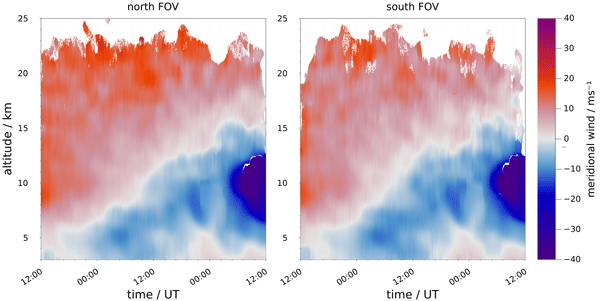
A novel lidar system with five beams measured horizontal and vertical winds together, reaching altitudes up to 25 km. Developed in Germany, it revealed accurate horizontal wind data compared to forecasts, but vertical wind estimates differed. The lidar's capability to detect small-scale wind patterns was highlighted, advancing atmospheric research.
Ralph Latteck and Damian J. Murphy
Ann. Geophys., 42, 55–68, https://doi.org/10.5194/angeo-42-55-2024, https://doi.org/10.5194/angeo-42-55-2024, 2024
Short summary
Short summary
This paper gives an overview of continuous measurements of polar mesophere summer echoes (PMSE) by VHF radars at Andøya (69° N) and Davis (69° S). PMSE signal strengths are of the same order of magnitude; significantly fewer PMSE were observed in the Southern than the Northern Hemisphere. Compared to Andøya, the PMSE season over Davis starts ~7 d later and ends 9 d earlier; PMSE occur less frequently but with greater seasonal/diurnal occurrence variability, reaching higher peak altitudes.
Jennifer Hartisch, Jorge L. Chau, Ralph Latteck, Toralf Renkwitz, and Marius Zecha
Ann. Geophys., 42, 29–43, https://doi.org/10.5194/angeo-42-29-2024, https://doi.org/10.5194/angeo-42-29-2024, 2024
Short summary
Short summary
Scientists are studying the mesosphere and lower thermosphere using radar in northern Norway. They found peculiar events with strong upward and downward air movements, happening frequently (up to 2.5 % per month) from 2015 to 2021. Over 700 such events were noted, lasting around 20 min and expanding the studied layer. A total of 17 % of these events had extreme vertical speeds, showing their unique nature.
Eframir Franco-Diaz, Michael Gerding, Laura Holt, Irina Strelnikova, Robin Wing, Gerd Baumgarten, and Franz-Josef Lübken
Atmos. Chem. Phys., 24, 1543–1558, https://doi.org/10.5194/acp-24-1543-2024, https://doi.org/10.5194/acp-24-1543-2024, 2024
Short summary
Short summary
We use satellite, lidar, and ECMWF data to study storm-related waves that propagate above Kühlungsborn, Germany, during summer. Although these events occur in roughly half of the years of the satellite data we analyzed, we focus our study on two case study years (2014 and 2015). These events could contribute significantly to middle atmospheric circulation and are not accounted for in weather and climate models.
Ashique Vellalassery, Gerd Baumgarten, Mykhaylo Grygalashvyly, and Franz-Josef Lübken
Ann. Geophys., 41, 289–300, https://doi.org/10.5194/angeo-41-289-2023, https://doi.org/10.5194/angeo-41-289-2023, 2023
Short summary
Short summary
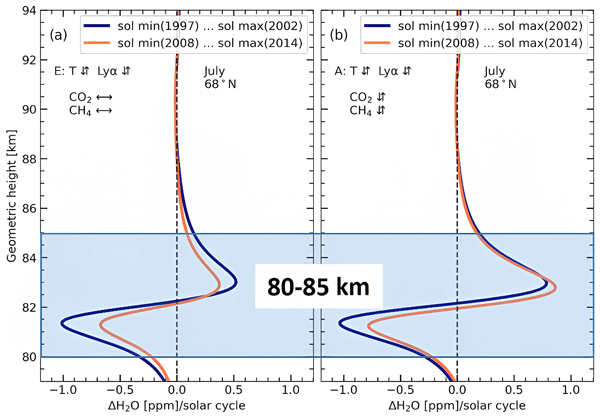
The solar cycle affects the H2O concentration in the upper mesosphere mainly in two ways: directly through photolysis and, at the time and place of NLC formation, indirectly through temperature changes. The H2O–Lyman-α response is modified by NLC formation, resulting in a positive response at the ice formation region (due to the temperature change effect on the ice formation rate) and a negative response at the sublimation zone (due to the photolysis effect).
Cited articles
Batchelor, G. K.: Small-scale variation of convected quantities like temperature in a turbulent fluid, J. Fluid Mech., 5, 113–133, 1959. a
Berger, U. and Lübken, F.-J.: Trends in mesospheric ice layers in the Northern Hemisphere during 1961–2013, J. Geophys. Res.-Atmos., 120, 11277–11298, https://doi.org/10.1002/2015JD023355, 2015. a, b
Bremer, J., Hoffmann, P., Latteck, R., and Singer, W.: Seasonal and long-term variations of PMSE from VHF radar observations at Andenes, Norway, J. Geophys. Res.-Atmos., 108, https://doi.org/10.1029/2002JD002369, 2003. a
Bremer, J., Hoffmann, P., Höffner, J., Latteck, R., Singer, W., Zecha, M., and Zeller, O.: Long-term changes of mesospheric summer echoes at polar and middle latitudes, J. Atmos. Solar Terr. Phys., 68, 1940–1951, https://doi.org/10.1016/j.jastp.2006.02.012, 2006. a, b
Chilson, P. B., Kirkwood, S., and Nilsson, A.: The Esrange MST radar: A brief introduction and procedure for range validation using balloons, Radio Science, 34, 427–436, https://doi.org/10.1029/1998RS900023, 1999. a
Cho, J. Y. N. and Röttger, J.: An updated review of polar mesosphere summer echoes: Observation, theory, and their relationship to noctilucent clouds and subvisible aerosols, J. Geophys. Res., 102, 2001–2020, 1997. a
Czechowsky, P., Schmidt, G., and Rüster, R.: The mobile SOUSY Doppler radar: Techical design and first results, Science, 19, 441–450, 1984. a
DeLand, M. T. and Thomas, G. E.: Update PMC trends derived from SBUV data, J. Geophys. Res., 120, 2140–2166, https://doi.org/10.1002/2014JD022253, 2015. a
Fiedler, J. and Baumgarten, G.: Solar and lunar tides in noctilucent clouds as determined by ground-based lidar, Atmos. Chem. Phys., 18, 16051–16061, https://doi.org/10.5194/acp-18-16051-2018, 2018. a
Fiedler, J., Baumgarten, G., Berger, U., and Lübken, F.-J.: Long-term variations of noctilucent clouds at ALOMAR, J. Atmos. Solar Terr. Phys., 162, 79–89, https://doi.org/10.1016/j.jastp.2016.08.006, 2017. a, b, c
Friedrich, M. and Torkar, K. M.: FIRI: A semiempirical model of the lower ionosphere, J. Geophys. Res.-Space, 106, 21409–21418, https://doi.org/10.1029/2001JA900070, 2001. a
Friedrich, M., Pock, C., and Torkar, K.: FIRI-2018, an Updated Empirical Model of the Lower Ionosphere, J. Geophys. Res.-Space, 123, 6737–6751, https://doi.org/10.1029/2018JA025437, 2018. a
Hervig, M. E., Rapp, M., Latteck, R., and Gordley, L. L.: Observations of mesospheric ice particles from the ALWIN radar and SOFIE, J. Atmos. Sol.-Terr. Phys., 73, 2176–2183, https://doi.org/10.1016/j.jastp.2010.08.002, 2011. a
Hocking, W. K.: Measurements of turbulent energy dissipation rates in the middle atmosphere by radar techniques: A review, Radio Science, 20, 1403–1422, 1985. a
Hocking, W. K. and Röttger, J.: Studies of polar mesosphere summer echoes over EISCAT using calibrated signal strengths and statistical parameters, Radio Science, 32, 1425–1444, 1997. a
Hocking, W. K., Kelley, M., Rogers, R., Brown, W. O. J., Moorcroft, D., and St. Maurice, J.-P.: Resolute Bay VHF radar: A multipurpose tool for studies of tropospheric motions, middle atmosphere dynamics, meteor physics, and ionospheric physics, Radio Sci., 36, 1829–1857, https://doi.org/10.1029/2000RS001005, 2001. a
Hoffmann, P., Singer, W., and Bremer, J.: Mean seasonal and diurnal variations of PMSE and winds from 4 years of radar observations at ALOMAR, Geophys. Res. Lett., 26, 1525–1528, https://doi.org/10.1029/1999GL900279, 1999. a, b, c
Hoffmann, P., Rapp, M., Singer, W., and Keuer, D.: Trends of mesospheric gravity waves at northern middle latitudes during summer, J. Geophys. Res.-Atmos., 116, https://doi.org/10.1029/2011JD015717, 2011. a
Kirkwood, S., Wolf, I., Nilsson, H., Dalin, P., Mikhaylova, D., and Belova, E.: Polar mesosphere summer echoes at Wasa, Antarctica (73° S): First observations and comparison with 68° N, Geophys. Res. Lett., 34, https://doi.org/10.1029/2007GL030516, l15803, 2007. a
Klostermeyer, J.: On the diurnal variation of polar mesosphere summer echoes, Geophys. Res. Lett., 26, 3301–3304, https://doi.org/10.1029/1999GL003629, 1999. a, b
Latteck, R.: LatteckARS2026, Leibniz Institute of Atmospheric Physics at the University of Rostock [data set], https://doi.org/10.22000/ny7zds9wghq3nt4f, 2026. a
Latteck, R. and Murphy, D. J.: Climatological comparison of polar mesosphere summer echoes over the Arctic and Antarctica at 69°, Ann. Geophys., 42, 55–68, https://doi.org/10.5194/angeo-42-55-2024, 2024. a
Latteck, R., Singer, W., and Bardey, H.: The ALWIN MST radar – Technical design and performances, in: Proceedings of the 14th ESA Symposium on European Rocket and Balloon Programmes and Related Research, Potsdam, Germany, edited by: Kaldeich-Schürmann, B., ESA Publications Dvision, ESTEC, Noordwijk, the Netherlands, vol. ESA-SP 437, 179–184, ISBN 92-9092-748-8, 1999. a, b, c
Latteck, R., Singer, W., Morris, R. J., Hocking, W. K., Murphy, D. J., Holdsworth, D. A., and Swarnalingam, N.: Similarities and differences in polar mesosphere summer echoes observed in the Arctic and Antarctica, Ann. Geophys., 26, 2795–2806, https://doi.org/10.5194/angeo-26-2795-2008, 2008. a
Latteck, R., Singer, W., Rapp, M., and Renkwitz, T.: MAARSY – the new MST radar on Andøya/Norway, Adv. Radio Sci., 8, 219–224, https://doi.org/10.5194/ars-8-219-2010, 2010. a, b
Latteck, R., Singer, W., Rapp, M., Vandepeer, B., Renkwitz, T., Zecha, M., and Stober, G.: MAARSY – The new MST radar on Andøya: System description and first results, Radio Science, 47, RS1006, https://doi.org/10.1029/2011RS004775, 2012. a, b, c
Li, Q., Rapp, M., Röttger, J., Latteck, R., Zecha, M., Strelnikova, I., Baumgarten, G., Hervig, M., Hall, C., and Tsutsumi, M.: Microphysical parameters of mesospheric ice clouds derived from calibrated observations of polar mesosphere summer echoes at Bragg wavelengths of 2.8 m and 30 cm, J. Geophys. Res.-Atmos., 115, https://doi.org/10.1029/2009JD012271, 2010. a
Lübken, F.-J.: Turbulent scattering for radars: a summary, J. Atmos. Sol.-Terr. Phys., 107, 1–7, https://doi.org/10.1016/j.jastp.2013.10.015, 2014. a
Lübken, F.-J., Rapp, M., Blix, T., and Thrane, E.: Microphysical and turbulent measurements of the Schmidt number in the vicinity of polar mesosphere summer echoes, Geophys. Res. Lett., 25, 893–896, 1998. a
Lübken, F.-J., Baumgarten, G., and Berger, U.: Long term trends of mesopheric ice layers: A model study, J. Atmos. Sol.-Terr. Phys., 214, 105378, https://doi.org/10.1016/j.jastp.2020.105378, 2021. a, b
Probert-Jones, J. R.: The Radar Equation in Meteorology, Q. J. R. Meteorol. Soc., 88, 485–495, 1962. a
Rapp, M. and Lübken, F.-J.: Polar mesosphere summer echoes (PMSE): Review of observations and current understanding, Atmos. Chem. Phys., 4, 2601–2633, https://doi.org/10.5194/acp-4-2601-2004, 2004. a
Rapp, M., Strelnikova, I., Latteck, R., Hoffmann, P., Hoppe, U.-P., Häggström, I., and Rietveld, M.: Polar Mesosphere Summer Echoes (PMSE) studied at Bragg wavelengths of 2.8 m, 67 cm, and 16 cm, J. Atmos. Sol.-Terr. Phys., 70, 947–961, https://doi.org/10.1016/j.jastp.2007.11.005, 2008. a, b, c
Sato, K., Kohma, M., Tsutsumi, M., and Sato, T.: Frequency spectra and vertical profiles of wind fluctuations in the summer Antarctic mesosphere revealed by MST radar observations, J. Geophys. Res.-Atmos., 2016JD025834, https://doi.org/10.1002/2016JD025834, 2017. a
Singer, W., Keuer, D., Hoffmann, P., Czechowsky, P., and Schmidt, G.: The ALOMAR SOUSY radar: Technical design and further developments, in: Proceedings of the 12th ESA Symposium on European Rocket and Balloon Programmes and Related Research, Lillehammer, Norway (ESA SP–370), 409–415, ISBN 92-9092-163-3, 1995. a, b
Skolnik, M.: Radar handbook, Electronics electrical engineering, McGraw-Hill, New York, NY, 2nd edn., ISBN 0-07-057913-X, 1990. a
Smirnova, M., Belova, E., Kirkwood, S., and Mitchell, N.: Polar mesosphere summer echoes with ESRAD, Kiruna, Sweden: Variations and trends over 1997–2008, J. Atmos. Sol.-Terr. Phys., 72, 435–447, https://doi.org/10.1016/j.jastp.2009.12.014, 2010. a
Smirnova, M., Belova, E., and Kirkwood, S.: Polar mesosphere summer echo strength in relation to solar variability and geomagnetic activity during 1997–2009, Ann. Geophys., 29, 563–572, https://doi.org/10.5194/angeo-29-563-2011, 2011. a
Swarnalingam, N., Hocking, W. K., and Argall, P. S.: Radar efficiency and the calculation of decade-long PMSE backscatter cross-section for the Resolute Bay VHF radar, Ann. Geophys., 27, 1643–1656, https://doi.org/10.5194/angeo-27-1643-2009, 2009. a
von Zahn, U. and Bremer, J.: Simultaneous and common-volume observations of noctilucent clouds and polar mesosphere summer echoes, Geophys. Res. Lett., 26, 1521–1524, https://doi.org/10.1029/1999GL900206, 1999. a

Short summary
Using 30 years of radar observations at Andøya, this study presents the world’s longest record of a rare summer phenomenon high above the Arctic. The season lasts about 104 days and is gradually starting earlier and ending later. Even after accounting for solar and geomagnetic effects, a small but steady rise remains. The strongest signals occur about 84 km up and show no long-term change, offering new insight into ongoing shifts in the upper atmosphere.
Using 30 years of radar observations at Andøya, this study presents the world’s longest record...